




The archives of the Memorial of the Revolution in Timișoara sometimes preserve genuine time capsules. Among them is an original copy of the special editions of the newspaper “Informația Bucureștiului”, printed in April and August 1961, dedicated to the first major achievements of the Soviet space program: the flight of Yuri Gagarin, the first human in space, and that of Gherman Titov, the first cosmonaut to spend more than one day in orbit.
Such publications are rarely found today in relatively well-preserved condition. Printed on low-quality paper, typical of the daily press of the period, they were intended for immediate consumption, and very few have survived for more than six decades. For this very reason, each authentic copy represents a valuable documentary source, allowing us to understand not only the historical events themselves, but also the way they were presented and interpreted by the communist regime.
What Does the Newspaper Report?
The edition of 12 April 1961 announces, in huge headlines, that “The First Man in Space!”, presenting the launch of the Vostok spacecraft and the successful return to Earth of Yuri Alekseyevich Gagarin. Its pages include technical details about the flight, the first messages transmitted from space, statements issued by the Soviet news agency TASS, as well as brief biographical notes about the cosmonaut.
The special edition of 6 August 1961 is dedicated to the launch of the Vostok-2 spacecraft, piloted by Gherman Titov. It contains information about the mission's objectives, orbital parameters, radio communications between the spacecraft and Earth, congratulatory telegrams addressed to the cosmonaut, and official statements by Soviet leaders and leaders of the communist bloc countries.
Seen through the eyes of today’s reader, the newspaper offers a fascinating glimpse into the enthusiasm sparked by the dawn of space exploration. The conquest of space was undoubtedly one of the greatest scientific achievements of the twentieth century, and the public interest in these events was genuine and immense.
Science Turned into an Instrument of Propaganda
Beyond the information about the space flights, these editions provide an almost perfect illustration of the way the press functioned in a totalitarian state.
In Romania in 1961, there was no free press. Newspapers were controlled by the Romanian Workers' Party and served to convey the official messages of the political leadership. Scientific achievements became evidence of the alleged superiority of the socialist system, while the success of scientists and cosmonauts was presented as an exclusive victory of communist ideology.
The grandiose headlines, the solemn language, and the constant repetition of expressions such as “the glorious Party”, “the great victory of socialism”, or “the epoch-making achievement of Soviet science” were intended to create a direct connection between technological achievement and the political legitimacy of the regime.
Not by chance, the newspaper's pages constantly alternate between scientific data, political statements, and congratulatory telegrams from communist leaders. Readers were encouraged to understand that space exploration was not merely a scientific achievement, but indisputable proof of the superiority of the Soviet Union and the communist system.
Gheorghe Gheorghiu-Dej's Servility
A special place is occupied by the statement of Gheorghe Gheorghiu-Dej, the leader of communist Romania at that time. His message is a telling example of the relationship of subordination that the Romanian leadership displayed toward Moscow in the early 1960s.
Dej extends his “heartfelt” congratulations to the Soviet people, the Communist Party of the Soviet Union, and Nikita Khrushchev, attributing the success of the space mission to the Soviet political leadership and presenting the achievement as yet another confirmation of the greatness of socialism.
Today, this speech can be read as a document of its time, illustrating the encomiastic and subservient language imposed on the leaders of the Soviet bloc countries. A few years later, Romania would adopt a more independent foreign policy, but in 1961 such statements faithfully reflected the country's official stance toward the Kremlin and the obligation to demonstrate constant loyalty to the Soviet center of power.
Why Is It Important to preserve such documents?
Such newspapers are important not only for what they tell us, but also for what they reveal between the lines. They show us how official discourse was constructed, how propaganda functioned, and how a genuine scientific achievement was used to reinforce an ideology and the cult of the superiority of the communist system.
Today, we can read these pages with a critical eye, while also appreciating their documentary value. They are authentic testimonies to an era in which information was carefully controlled, and the press became one of the most important instruments for shaping public opinion.
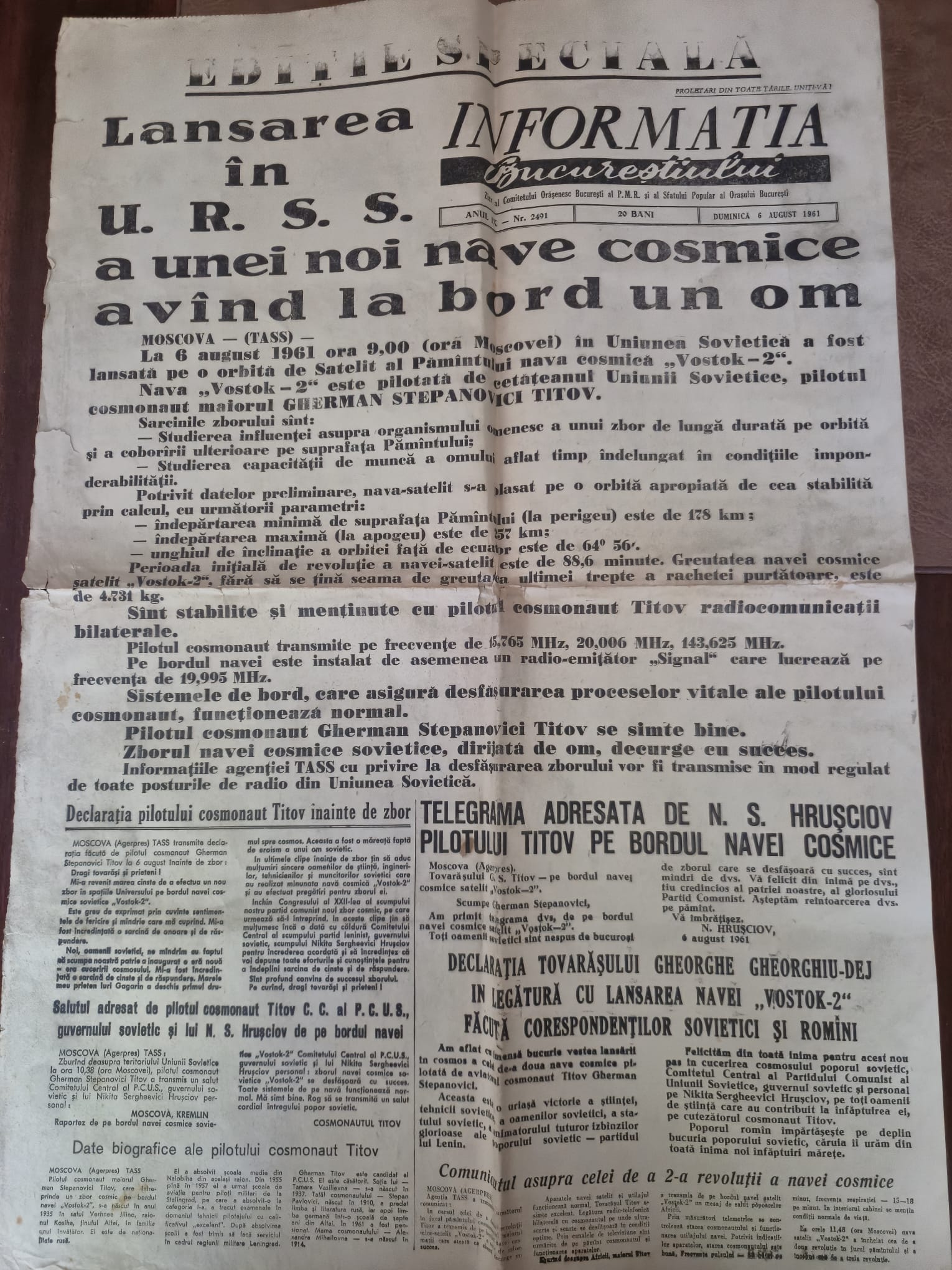
Special edition
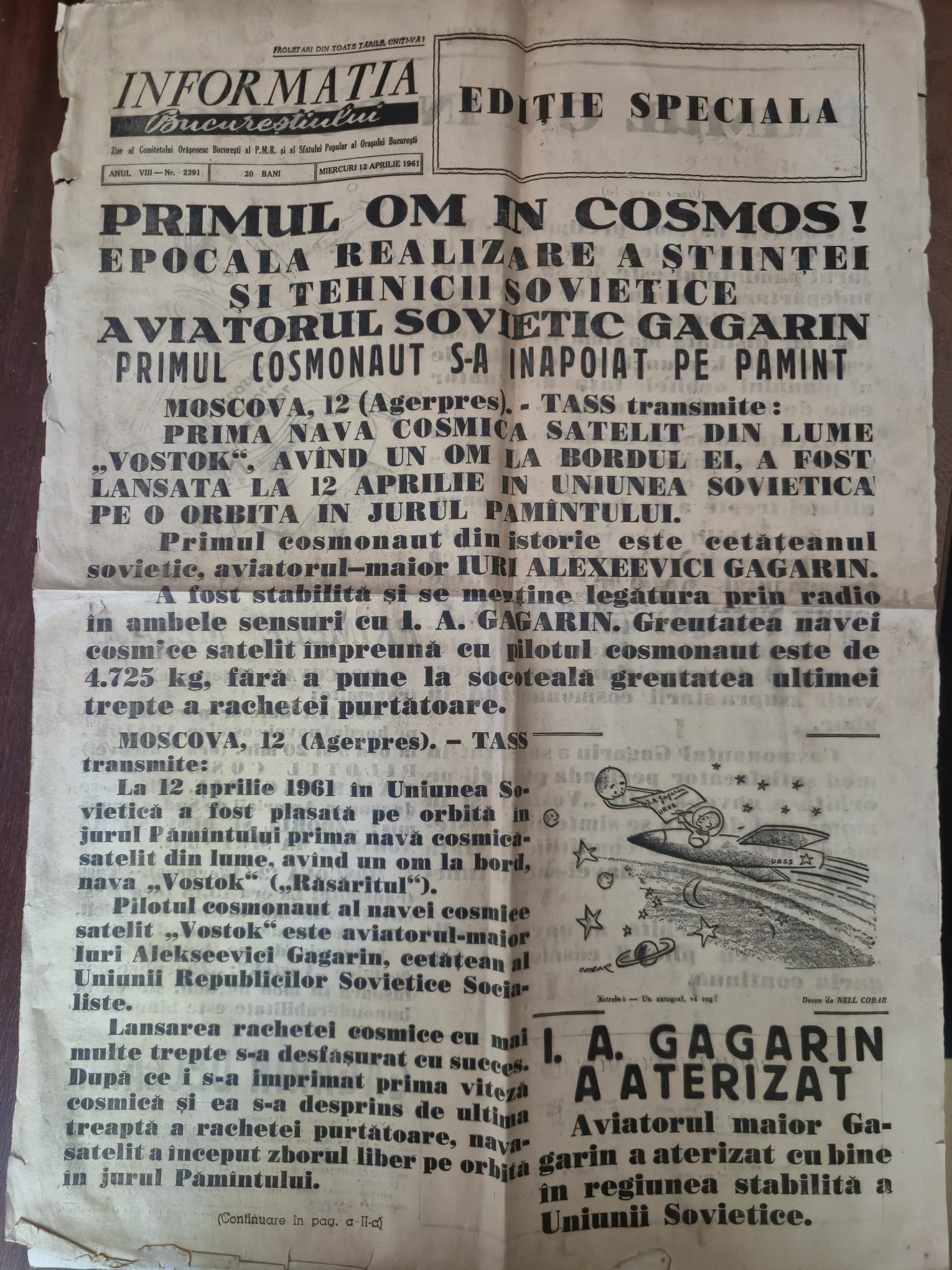
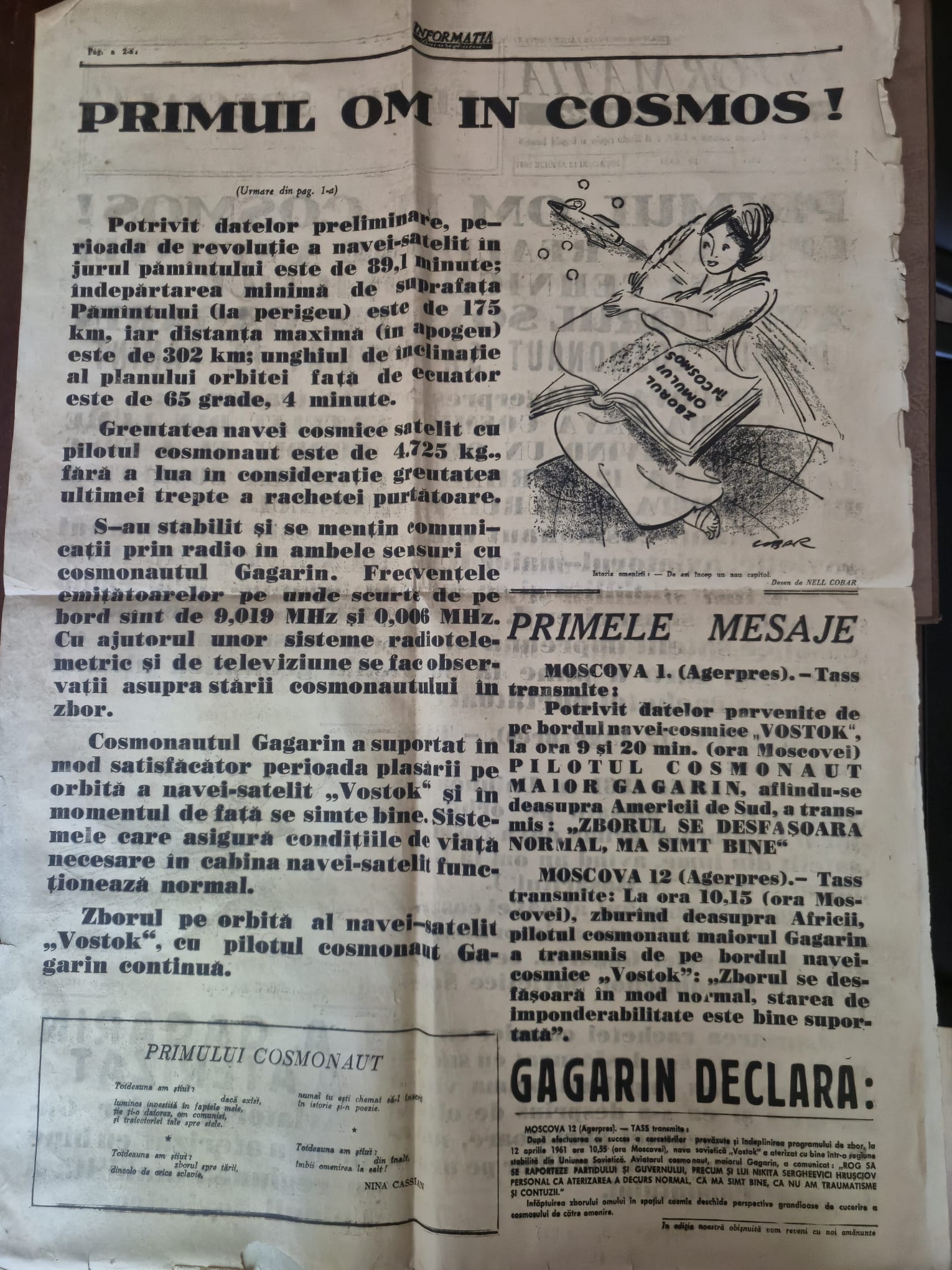 More than six decades after their publication, these special editions remain not only rare pieces of printed heritage, but also an invitation to discover history in all its complexity: with its great achievements, but also with the mechanisms of propaganda that accompanied them.