




Lucian Vasile Szabo
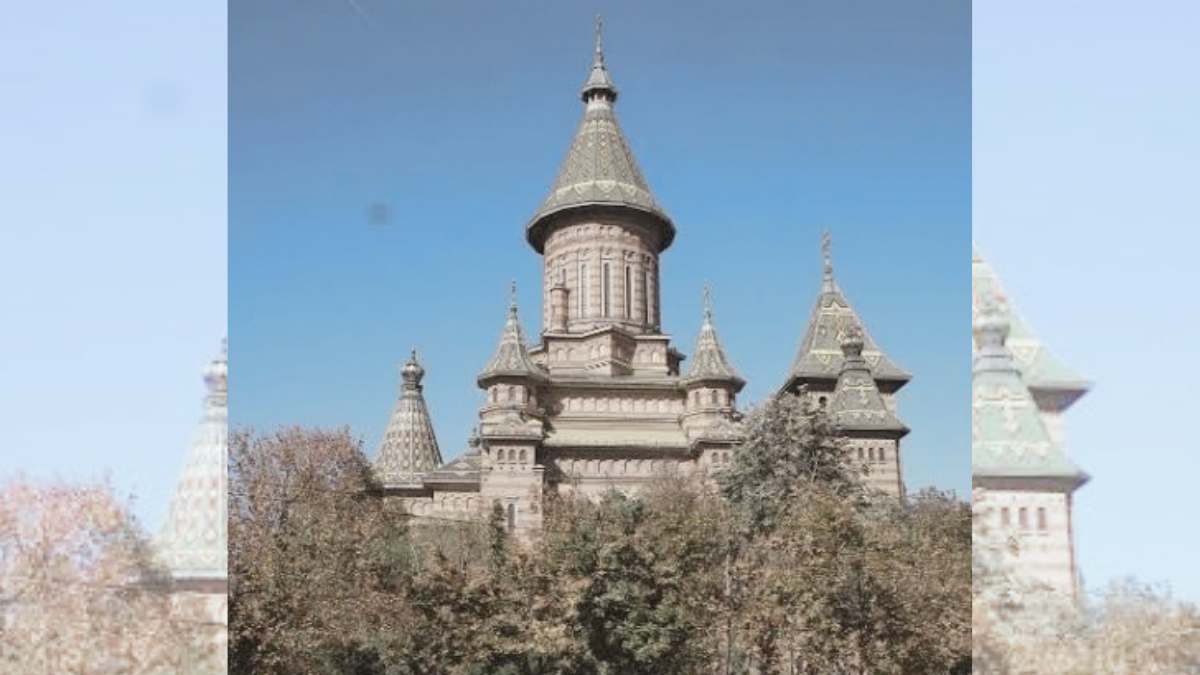
December 18, 1989, is rich in revolutionary significance, although we do not record as many events as those that took place on December 16, 17, 20, or 22, 1989. Nevertheless, it was a day of resistance, determination, and preparation for the confrontations to come. The repressive forces had taken control of the city, setting up fixed checkpoints and deploying mobile patrols throughout the city to prevent groups of demonstrators from forming. However, a tragic event would occur around midday, known as the episode in which fire was opened on the people gathered on the steps of the Metropolitan Cathedral in Timișoara. Carrying the Romanian tricolor flag with the socialist emblem cut out, several people gathered on the steps of the place of worship. Subsequent investigations revealed that the young man carrying the tricolor with the coat of arms of socialist Romania cut out was Sorin Leia.[1]. The image is significant because the demonstrators, who initially remained silent in their protest, believed they would be best protected in front of the Cathedral, placing their lives and hopes in God’s hands. Fire would be opened on them on several occasions, the members of the repressive forces being unimpressed by the religious symbol. Fire would be opened on the people gathered at the Cathedral, and there would be many casualties, both on the evening of December 17 and on December 18. The Cathedral was not in danger of being vandalized; nevertheless, nothing was done to stop the break-ins at the shops across the street, just a few meters from those who opened fire.
In the newspaper Renaşterea bănăţeană, issue no. 24, dated February 1, 1990, we also find a clarification regarding the dilemma surrounding the doors of the place of worship on December 18, 1989. As is known, fire was opened in the area of the Cathedral. There were deaths and injuries. Subsequent testimonies revealed that combined forces of the Army, the Securitate, and the Militia were present here, and General Mihai Chițac was one of the commanders of the repression. The controversy arose from the fact that when fire was opened, the people protesting on the steps of the Cathedral tried to take refuge inside the place of worship, but allegedly failed to do so. Archpriest Cornel Pleșu would maintain that the church’s regular schedule had been observed, that the doors had not been closed and that, in fact, the young man who was wounded and brought there at around 17:15 received medical care (but did not survive), while the people who had taken refuge in the holy place were carefully escorted out through a side door, so as not to endanger their lives. The fact that the doors were open and that people were actually entering and leaving is also supported by another researcher, who carefully analyzed the events.[2].
The archpriest’s account is not entirely clarifying, but it has at least the merit of providing information about what happened on December 18, 1989, at around 16:50 inside the place of worship: “At 16:50, Vespers began, but after a quarter of an hour, fire began to be opened on the young people who were on its steps, holding lit candles in their hands. Under these circumstances, the children rushed inside, causing panic. In these conditions, Father Victor Mițiga and Deacon Eugen Bendariu interrupted the religious service to see what was happening. A boy wounded in the head was brought into the Cathedral and bandaged by a female doctor who was in the church, using bandages from the first-aid station. Father Victor Mițiga, seeing the desperate state the children were in—some had begun to cry—then began to lead them out of the church through the side door facing Capitol, but this proved impossible, because the moment the door was opened, fire was opened from the direction of the cinema. The children re-entered the Cathedral, and Father Victor Mițiga then began evacuating them through the door on the right-hand side (facing the tram), on the condition that they leave one by one. In this way, everyone who had been inside escaped with their lives. The wounded boy from the church was accompanied by Father Victor Mițiga to the ambulance. At 18:00, the holy place was closed, and the cleaning staff cleaned the premises, washing away the blood that had flowed from the body of the shot child.”[3]. The archpriest also provides clarification regarding the activities of Metropolitan Nicolae of Banat during that period, mentioning that he was in Constantinople and then in Bucharest.[4].
The involvement of General Mihai Chițac is evident, and the incident at the Cathedral was also recorded in official documents, the contents of which were reproduced in a volume by Gino Rado.[5]. It was a bloody episode, as several people died there and others were wounded. Some aspects are clarified by the testimony of Avram Gliguță, who was wounded at that location. He would also recount the moment Sorin Leia was killed: “We pushed and shoved to get into the Cathedral. The Cathedral has a double door, but in the crush, one of the doors closed. We were crouching down, trying to squeeze our way inside. Another person and I, whom I later learned was named Sorin Leia, raised our heads to see what was happening, when a burst of gunfire was fired through us, from below upwards. Sorin Leia was hit right in the middle of the forehead. The bullet that exited his head also struck me at the base of my neck, on the right-hand side.”[6].
Official reports on the terror
Official documents summarize the incident tersely: 16:30: Groups of people gather in front of the Cathedral. Candles are lit, slogans are chanted. Fire is opened on the demonstrators (Judgment no. 2 of June 17, 1991, of the Timiș Extraordinary Military Tribunal). Marius Nemțoc is killed near the Cathedral, and very probably Ioan Măriuțac as well (the latter may also have been killed later, during the second opening of fire). Militia non-commissioned officers Constantin Țeighiu and Dumitru Asafti were brought to trial for the deaths of the young men Nemțoc and Măriuțac, but they were acquitted.[7].
In another episode in which fire was opened, Sorin Leia would be killed on the steps of the Cathedral. As we can see, there are discrepancies regarding the timing of the moments when fire was opened. However, these differences in timing most likely have a psychological explanation. The participants (the demonstrators, first and foremost) were under the influence of intense emotions and under extraordinary pressure, which may explain these variations, especially since no one was stopping to look at their watch very often. As Titus Suciu indicates, drawing on witness statements, Sorin Leia was allegedly killed at around 16:30.[8]. However, the witness Avram Gliguță, who was wounded when Sorin Leia was killed, stated that he had previously seen pools of clotted blood in front of the Cathedral, leading to the conclusion that, before Leia was killed, there had been another distinct episode in which fire was opened, most likely the one in which Nemțoc and Măriuțac were shot.[9]. It was officially recorded: “17:15. Demonstrators appeared in front of the Cathedral carrying candles and refused to disperse. They were ordered to disperse, and fire was opened on them. They fled and barricaded themselves inside the Cathedral” (Journal of the 18th Mechanized Division, Timișoara).[10]. 17:00–17:10 is the most likely time frame in which fire was opened, although there may have been other instances that were not recorded in the military units’ combat logs.
It is noteworthy that information was transmitted rapidly from the field to the command center, the means of communication being the radio transceivers installed in armored personnel carriers (APCs) or carried by military personnel deployed at various locations throughout the city. Communication was swift, and the information was recorded tersely in the combat logs. Later, when attempts would be made to establish the truth about the events that had taken place during those bloody days, the commanders of the military units involved (many of whom remained in their positions even after Ceaușescu’s fall) would issue reports presenting the facts in a light favorable to themselves, often in contradiction with what had happened and even with the information recorded in the combat logs. The methods used involved keeping unfavorable details silent and shifting responsibility onto the other components of the repressive forces, particularly the Securitate and the Militia. Of course, these forces also caused casualties, but a significant number of deaths and injuries were caused by the Army.
[1] Dumitru Tomoni, Sorin Leia, eroul martir de pe treptele catedralei, Editura Eurostampa, Timișoara, 2016, p. 96.
[2] Ibidem.
[3] Renașterea bănățeană, an I, nr. 24, 1 februarie 1990.
[4] Lucian-Vasile Szabo, Jurnaliști, eroi, teroriști, Editura Memorialul Revoluției 1989, Timișoara, 2009, pp. 78-79.
[5] Gino Rado, Incursiune în istoricul instituţiilor participante la reprimarea revoluției române din 1989. Timişoara – Decembrie 1989, Editura Memorialul Revoluţiei 1989, Timişoara, 2011, p. 194.
[6] Avram Gliguţă, Declaraţie de martor, 1990, Dosar nr.4/P/1990 al Procuraturii Militare Timişoara, arhiva Asociaţiei Memorialul Revoluţiei 16-22 decembrie 1989, Timişoara.
[7] Lucian-Vasile Szabo și Gino Rado, Revoluția de la Timișoara din decembrie 1989 pe înțelesul tuturor, Editura Memorialul Revoluției 1989, Timișoara 2016, p. 56.
[8] Titus Suciu, Reportaj cu sufletul la gură, Editura Facla, Timişoara, 1990, p. 157.
[9] Marius Mioc, Revoluția de la Timișoara prin mărturii, Editura Partoș, Timișoara, 2019, p. 100.
[10] A fost reluat în Gino Rado, Incursiune în istoricul instituţiilor participante la reprimarea revoluției române din 1989. Timişoara – Decembrie 1989, Editura Memorialul Revoluţiei 1989, Timişoara, 2011.